
Wild Orangutan Trekking in Sumatra: Lucky Encounters & How to Plan an Ethical Tour
Disclosure: This blog is reader-supported, and some posts contain affiliate links. If you make a booking, I may earn a small commission—at no extra cost to you. Thank you for keeping me writing and doing what I love!
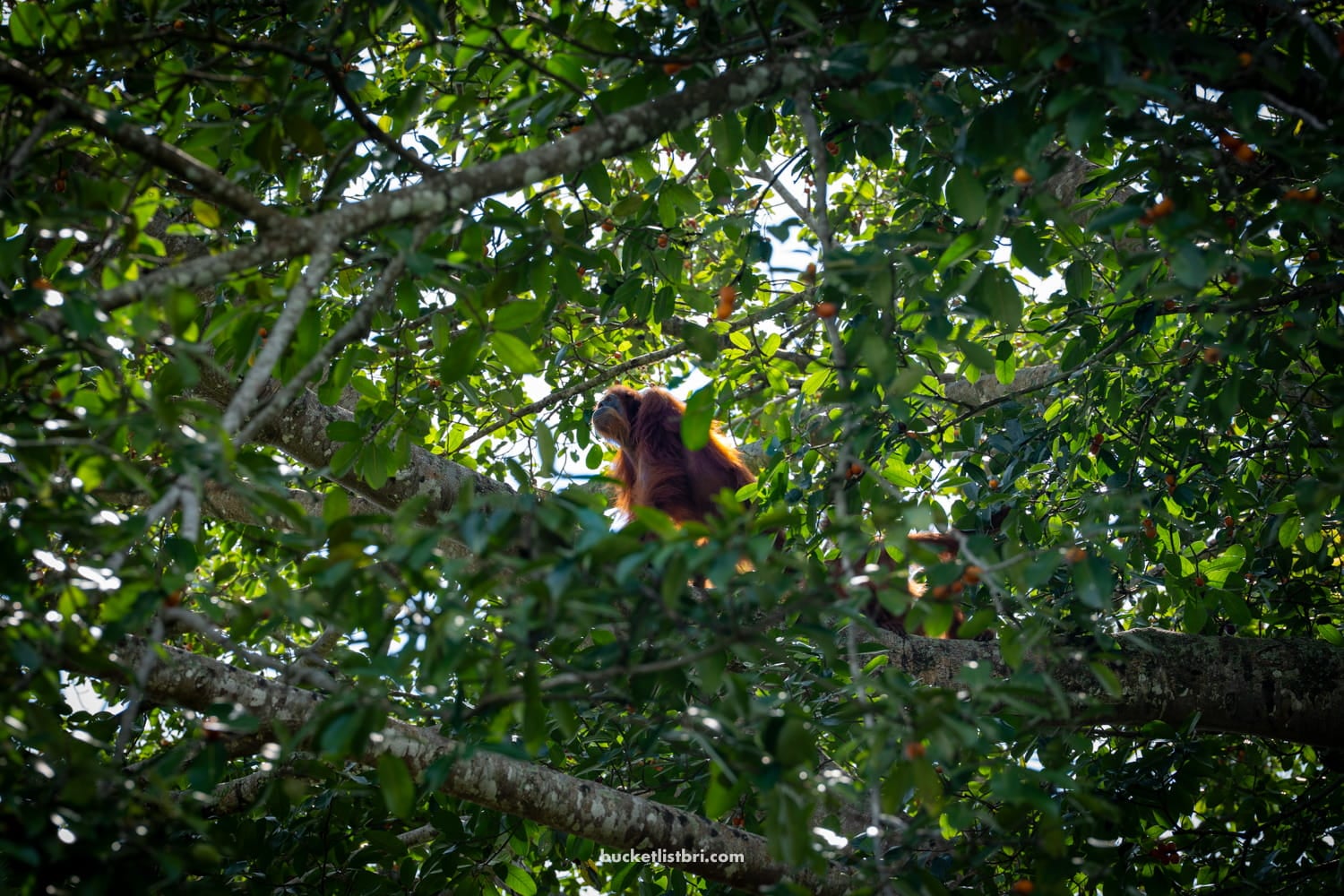
It was some time after crossing the rubber tree farms, bark oozing their white sap, and our early encounter with an endemic Thomas’s leaf monkey that we glimpsed her, our group’s first sighting of a semi-wild female adult orangutan in Gunung Leuser National Park, which spans a whopping 8,000 km² across the North Sumatra and Aceh provinces of Sumatra, Indonesia.
Cameras with long lenses and pointed fingers revealed her. My eyes followed. My heavy breathing slowed to a hushed awe as I made out her form amid the jungle’s trees and foliage.
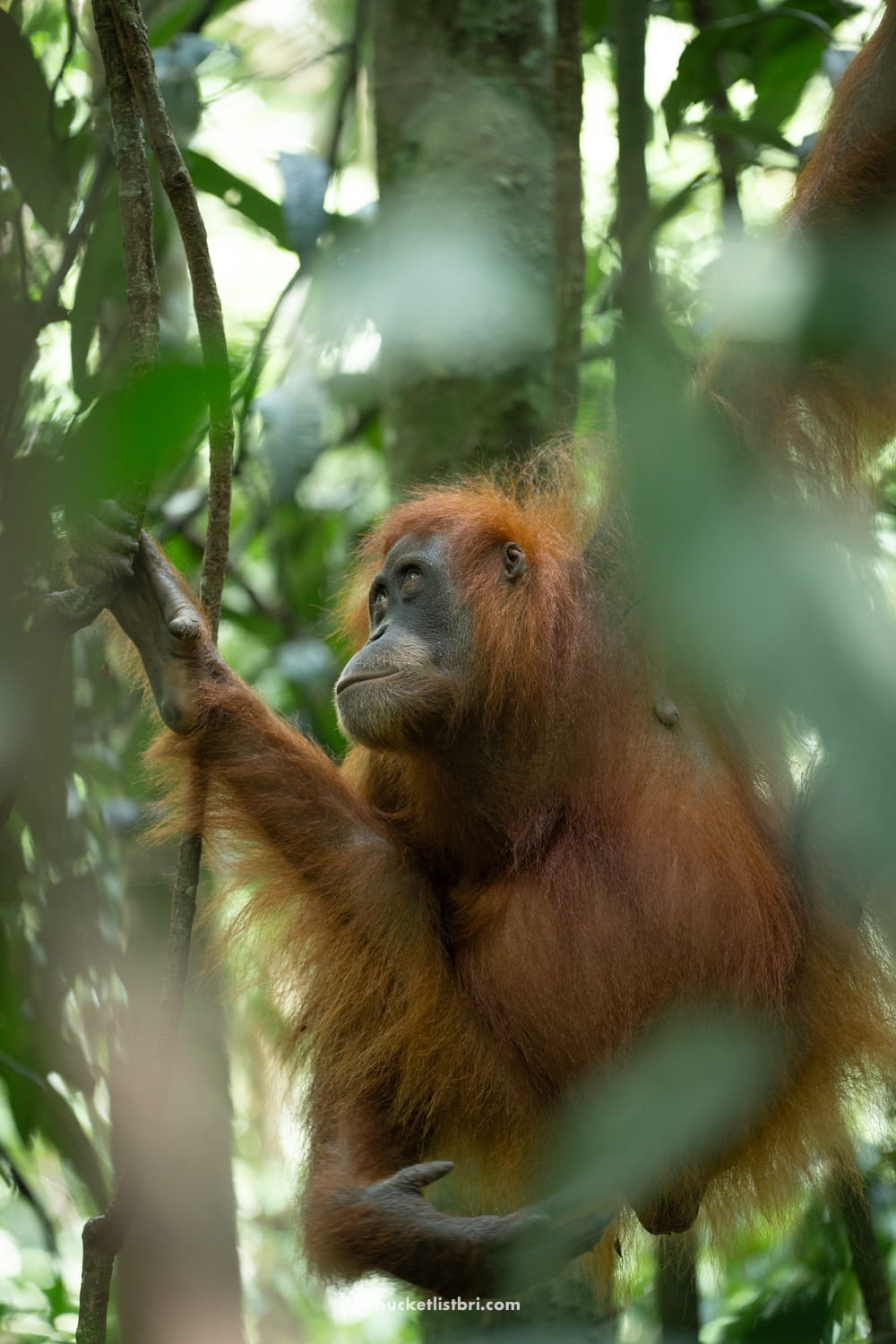
Suddenly, there she was, a slow-moving, large — very large — alert, yet calm, gentle-appearing creature, straddling multiple branches. Peering back at us, watching with eyes all too familiar, hands all too similar.
That’s when my brain realized it: Could it be? I’m actually trekking for orangutans in the Sumatran jungle right now, and there one is before my very eyes, in her natural environment where she belongs. How freaking cool is this?!
That moment solidified it: This was worth it — the long travel days to get here, the streams of sweat soaking every pore on my body, the ache from my backpack digging its weight in.
And if that’s you, too — wondering if seeing wild orangutans in Sumatra is worth it, just know that it is. But there are a few things I would have liked to know beforehand, which I’ll go into in more detail in this guide!
If you are planning a trip to Sumatra and wondering how to organize a tour from Bukit Lawang to see the orangutans, here’s what to consider and how to choose an ethical tour.
Sumatra Orangutan Trekking – Quick Overview
📍 Location: Bukit Lawang, North Sumatra, Indonesia — a laid-back jungle village along the river!
🦧 Main Highlight: Trek through the jungle to see semi-wild and wild Sumatran orangutans in their natural habitat
🛏️ Stay: Bukit Lawang Ecolodge by the river
🥾 Trek Length: Usually 1-day, 2-day, or multi-day jungle treks
💦 Expect: High humidity, muddy trails, river crossings, steep climbs, and dense rainforest
🎒 What to Bring: Hiking shoes, rain jacket, swimsuit, dry bag, electrolytes, bug spray, and lightweight clothes
🌧️ Best Time to Go: Generally April–September for drier trekking conditions
Where & How to Plan Your Orangutan Trekking Tour
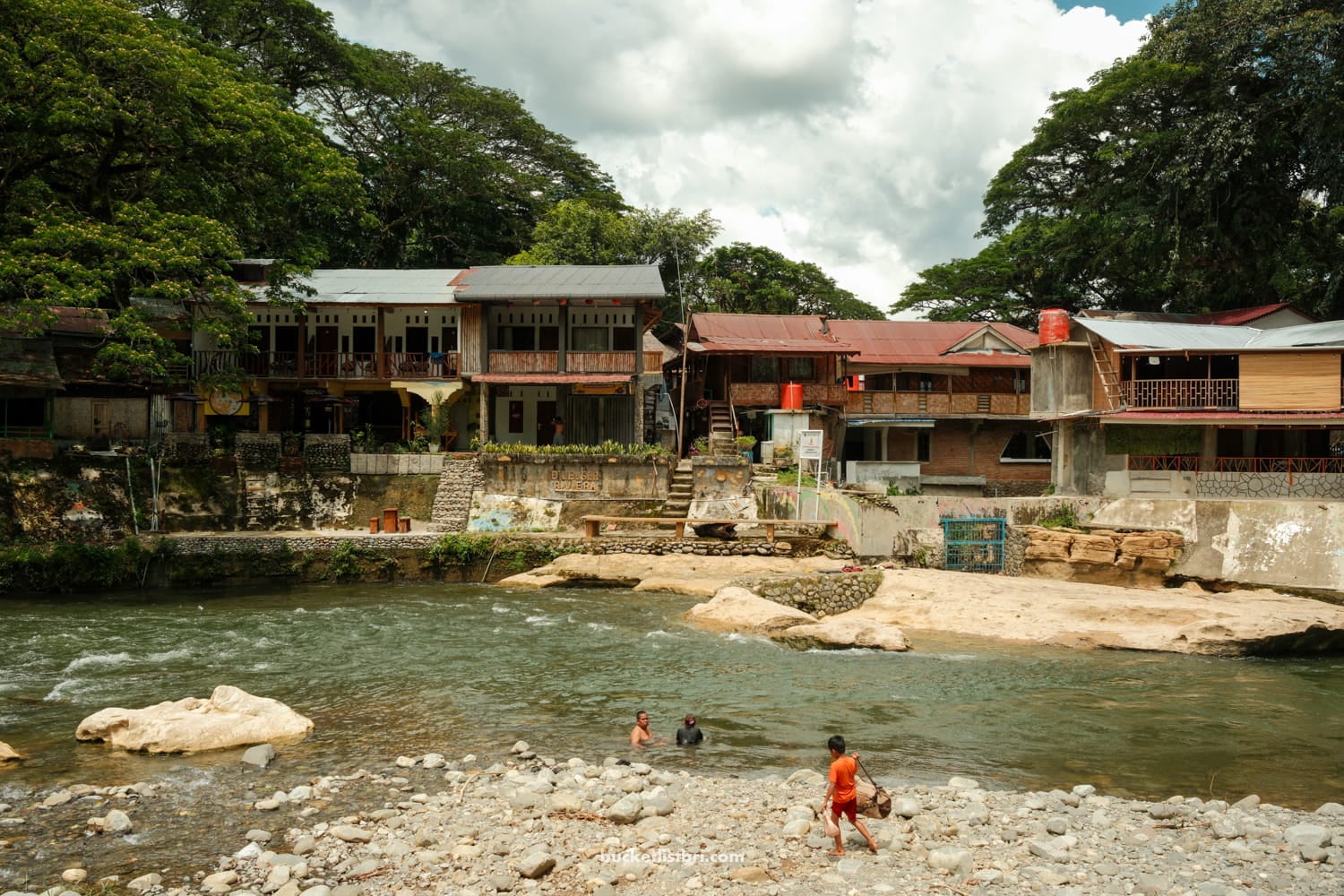
While Sumatra is still considered off the beaten track for orangutan trekking compared to Borneo, there’s no shortage of licensed operators and guides who can take you into the jungle departing from Bukit Lawang, which is the main departure point for trekking in Gunung Leuser National Park.
Getting to Bukit Lawang takes about 3 hours from Medan, though traffic can make it much longer.
- Book a private van (most tours include transfer; avoid public vans, as they seem outrageously cheap but terribly uncomfortable!).
- Stay overnight (ideal: 2 nights) at Bukit Lawang Ecolodge (we loved it here!) 🌿
- Book a 2-day trek, with an optional river tube float back to the village on day two
You can do a single-day or multi-day trek from Bukit Lawang.
The most popular is a 2-day trek with one overnight in tents. However, our guide mentioned they can do even up to 5–6 nights in the jungle for those who want a truly adventurous, off-beat jungle experience!
Just note that two days are sufficient to see wildlife, including orangutans, gibbons, and monkeys. The elusive Sumatran tiger, however, is rare!
Our private group, which I hosted for my Bootstrap Blogging community, contracted a local guide through Intrepid Travel’s network.
Our jungle guide, named Mail (pronounced Mile), was wonderful, energetic, and very knowledgeable. I’d definitely recommend going with him and his team, if possible! You can reach Mail via his family website: Bukit Lawang Tour & Trekking.
Alternatively, you can check out the available tour options on Viator with Bukit Lawang Tours, led by local, licensed guides, which are highly rated.
What to Expect on a 2-Day Trek with Overnight Camp in Gunung Leuser National Park
- 🥾 ~8-hour hike to reach camp from Bukit Lawang
- 🍉 Includes 2x lunches, 1 breakfast, 1 dinner, and water breaks
- 🦧 Time for photographing the monkeys and orangutans
- ⛺️ Camp at a rustic riverside shelter with tents and an outhouse
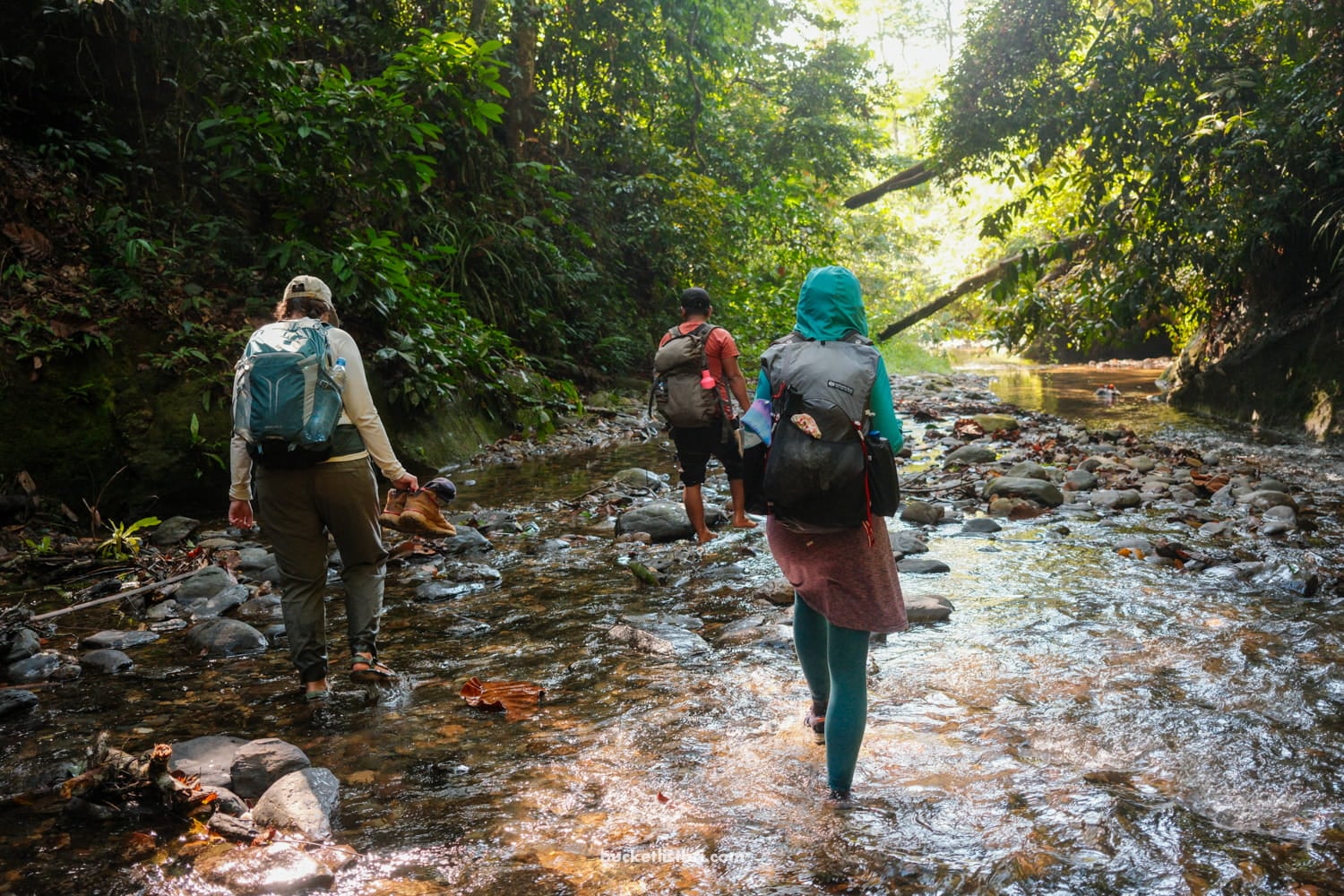
If you’re leaning toward the 2-day, 1-night jungle camp (and I HIGHLY recommend you do!), you will want to prep a little extra. The hike isn’t necessarily long, but the terrain is difficult, and the added humidity can feel sweltering.
On a 2-day hike from Bukit Lawang, you can expect to see the Sumatran orangutan (of which roughly 13,000 are left), the playful and endemic Thomas’s leaf monkey, plus the Pig-tailed Macaque and Long-tailed Macaque.
We also spotted a venomous pit viper on a branch and a flying Hornbill, but no sightings of the gibbons, sun bear, Sumatran tiger, rhino, or elephant!
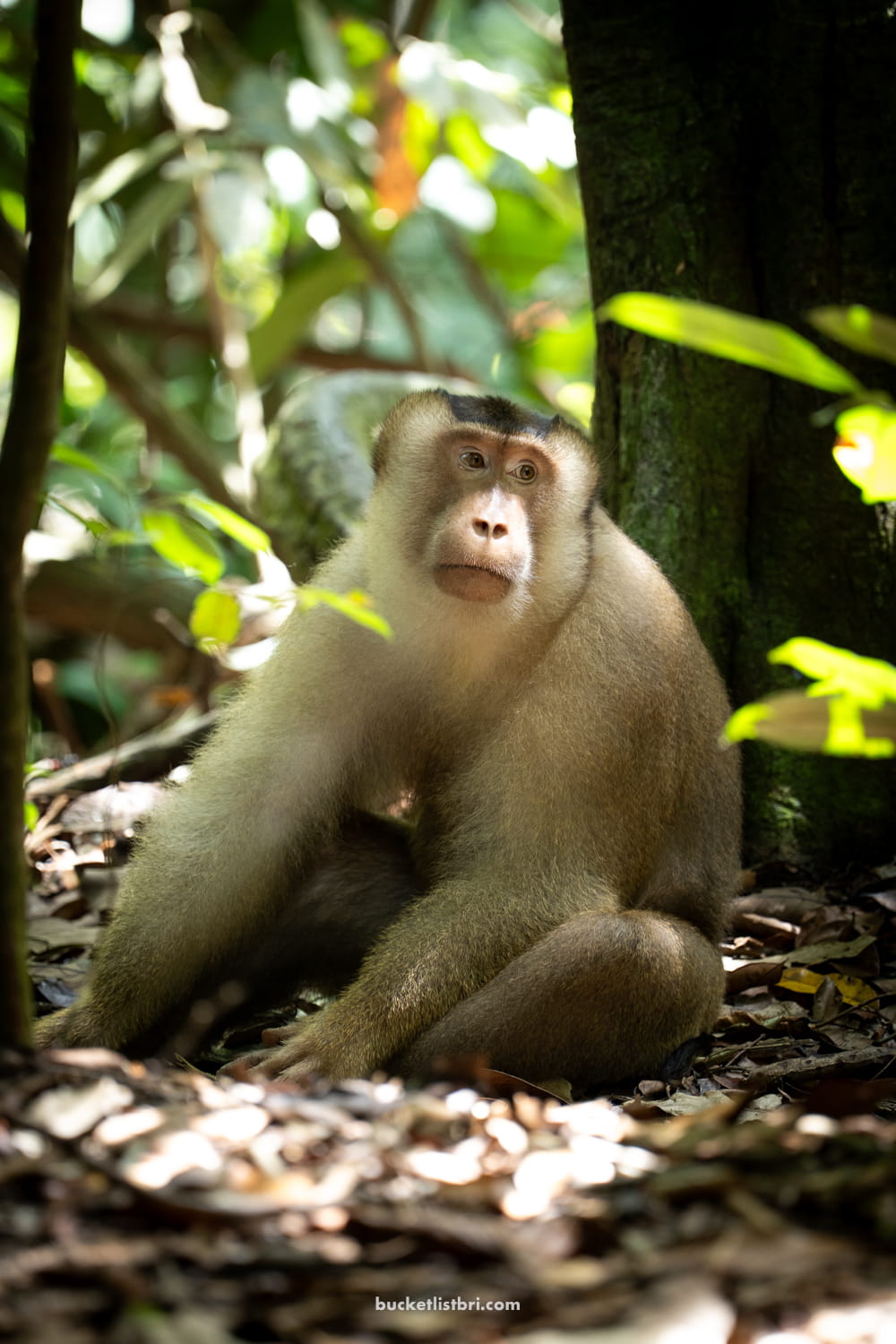
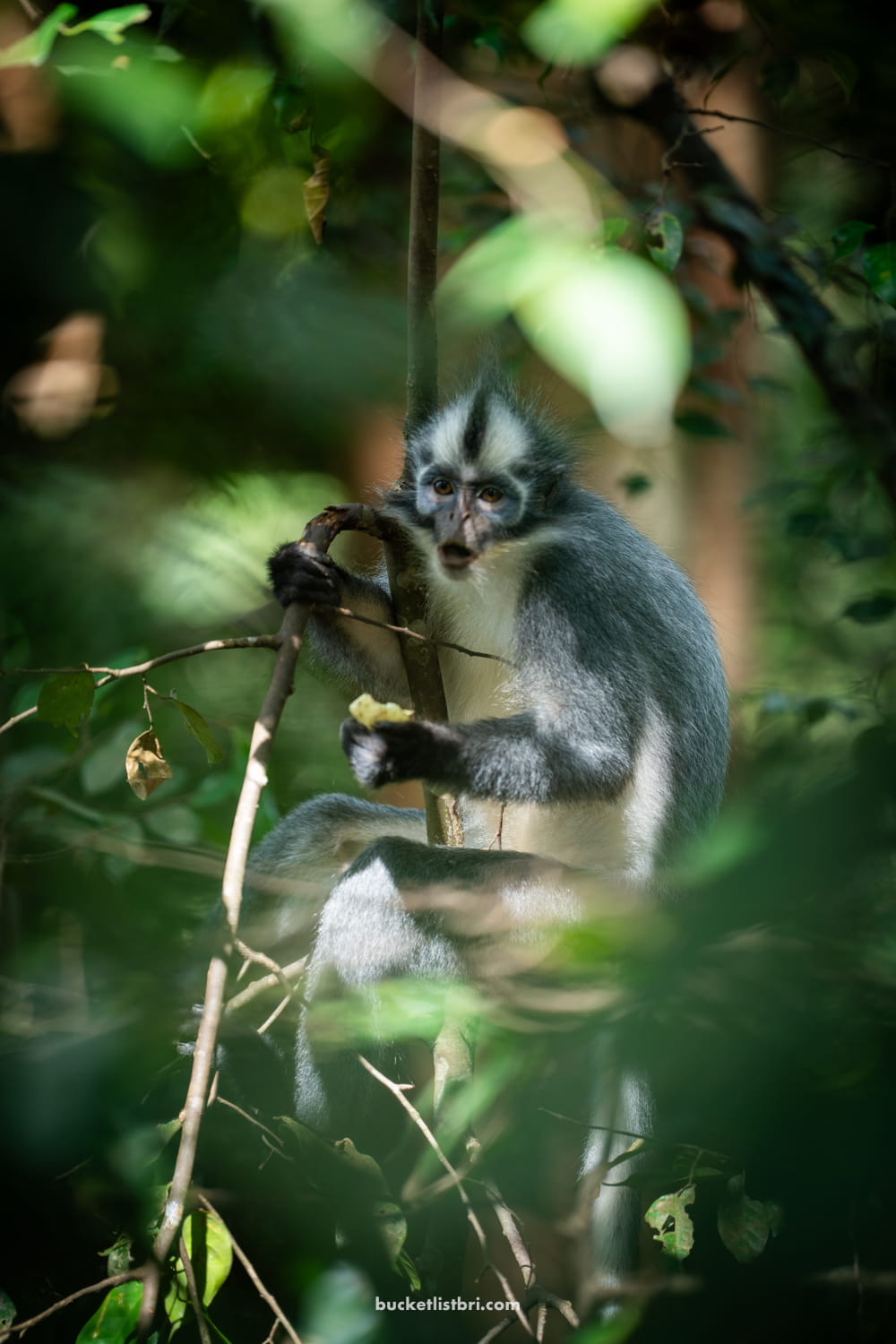
If you’re opting to DIY your own accommodation and hire a guide just for the trek, make sure you plan to stay two nights in Bukit Lawang village so you can have a prep day before your trek and a rest day after you arrive back.
Recommended lodges in Bukit Lawang:
- Bukit Lawang Ecolodge 🌿 (where we stayed!)
- Green Travel Lodge 🌺
- Jungle Inn 🙊
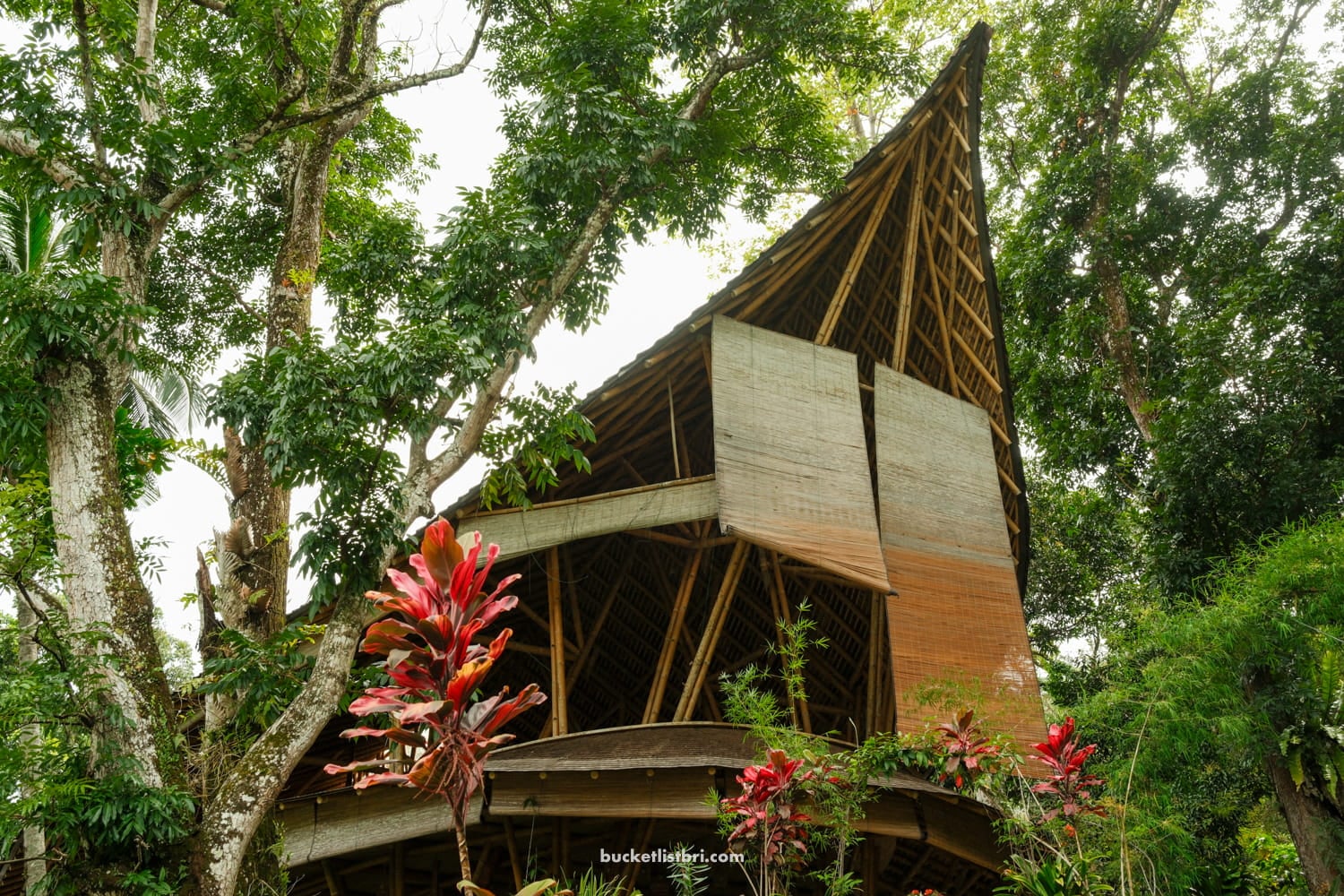
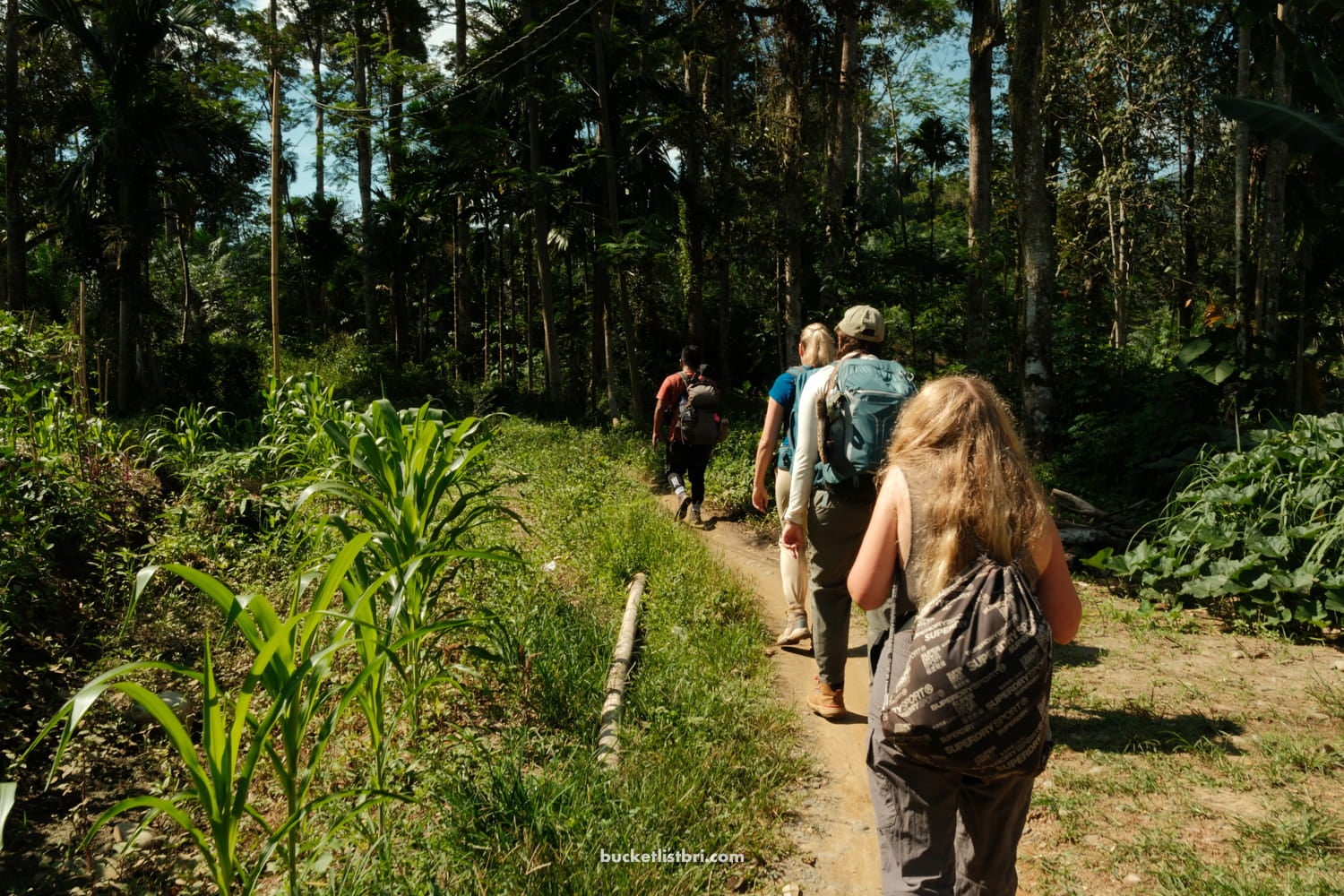
Your hike into Gunung Leuser will depart just behind Bukit Lawang village (close to the Ecolodge).
The first day’s hike lasted from ~9 am to 5 pm, with stops for orangutan sightings, multiple breaks, and, of course, lunch!
Still, it’s quite a challenging hike to reach the riverside camp, where you’ll sleep inside sheltered tents. The river is really nice to dip in after such a hot, sweaty day of hiking, so pack a swimsuit and don’t forget a towel! You’ll definitely want to bring a change of dry clothes for sleeping and your 2nd day.
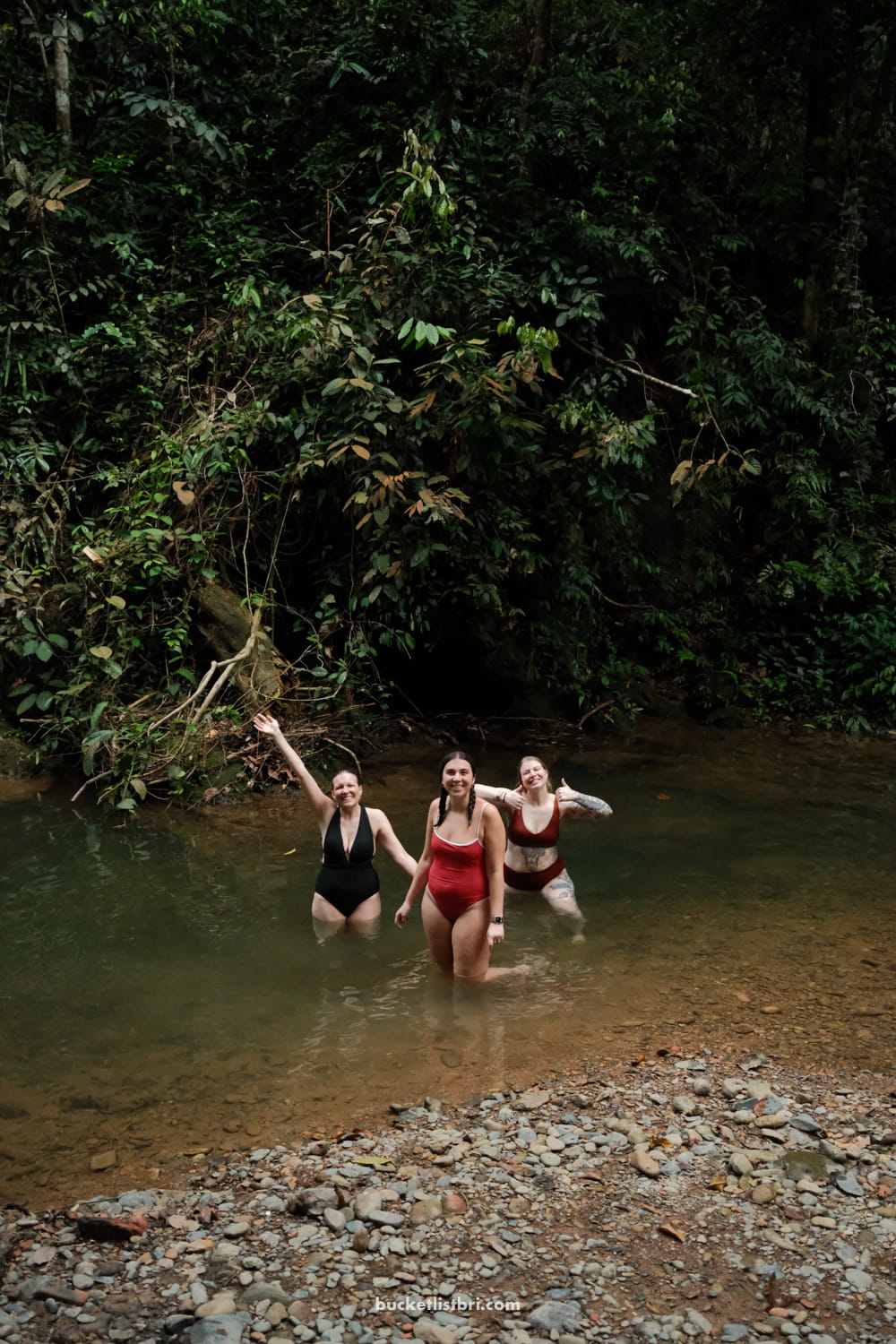
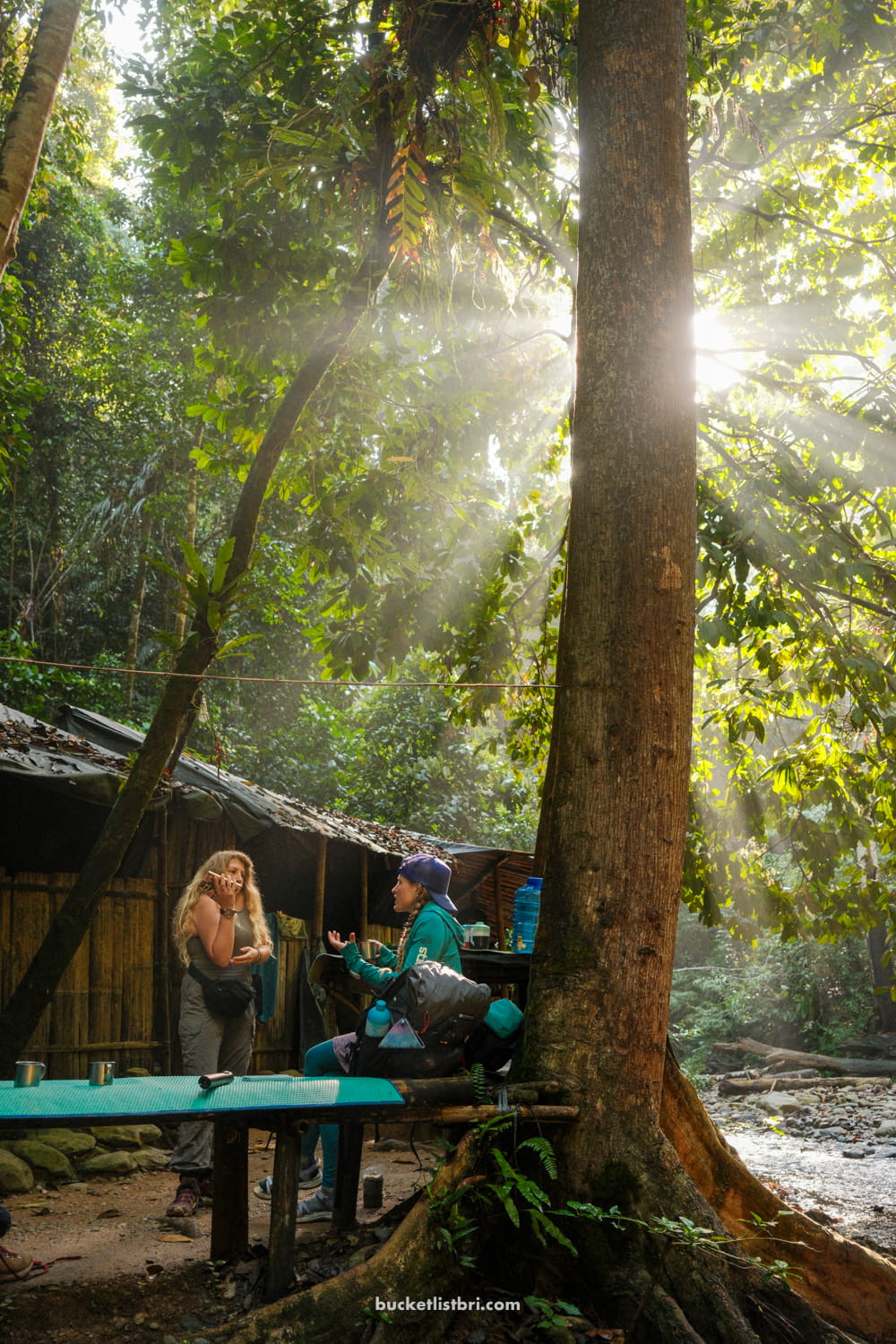
Discuss with your tour leader in advance if you’ll be hiking out via the short or long(er) route on day two, or if your group will float back down the river on tubes!
Our group opted for a shorter walk; however, we still got super lucky and saw a wild female orangutan (mother with her child) up in an Avatar-like tree! 🌳
Sumatra Jungle Trekking Prep Checklist
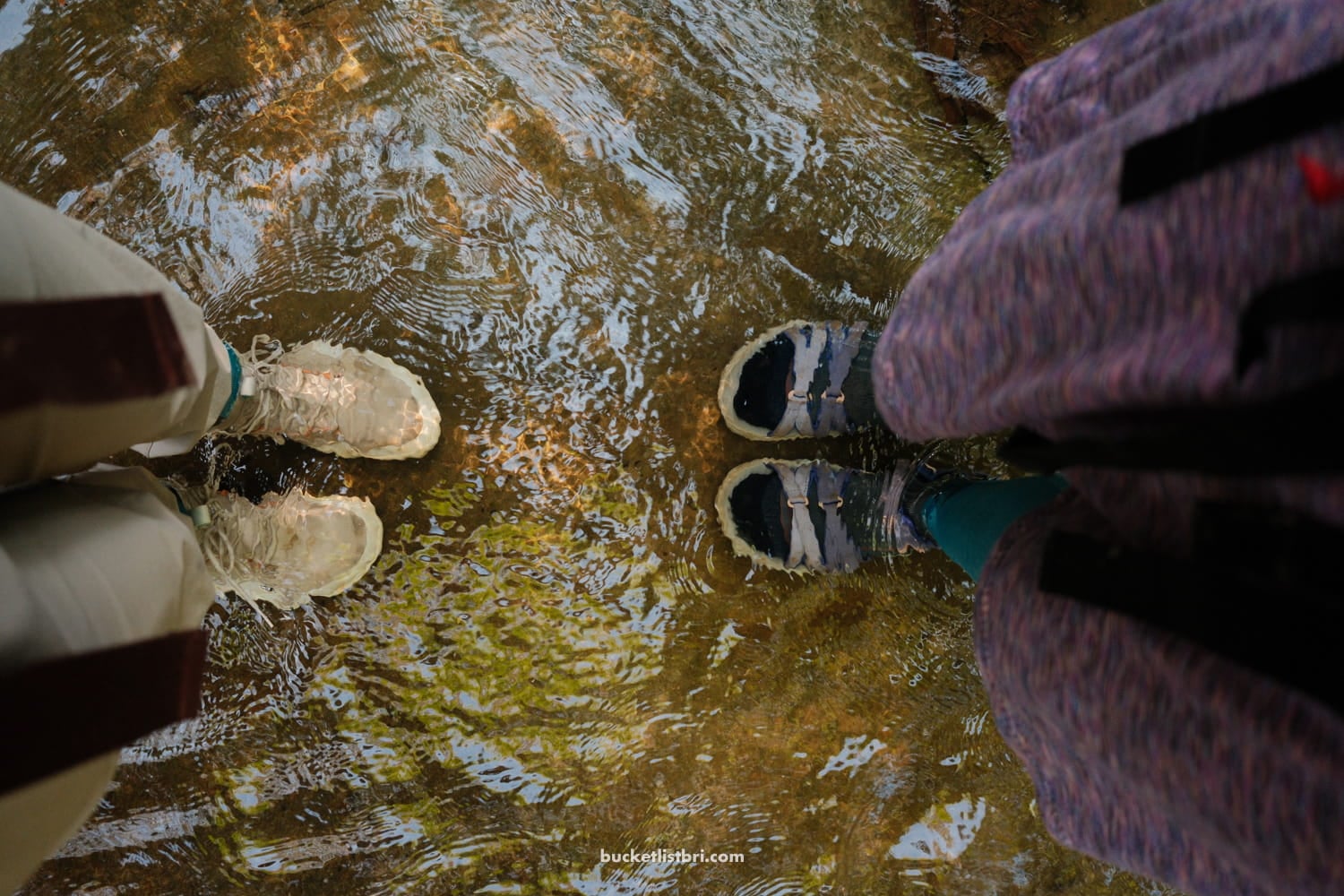
Our group definitely underestimated the heat and weight of our packs on this trek — so here’s what I’d pack again (and leave behind, marked as optional!):
To wear to hike:
- Long trousers
- Loose long-sleeve
- Bandana (for sweat)
- Hat
- Sunscreen
- Mosquito repellent
- Water
- Cameras
To carry for camp:
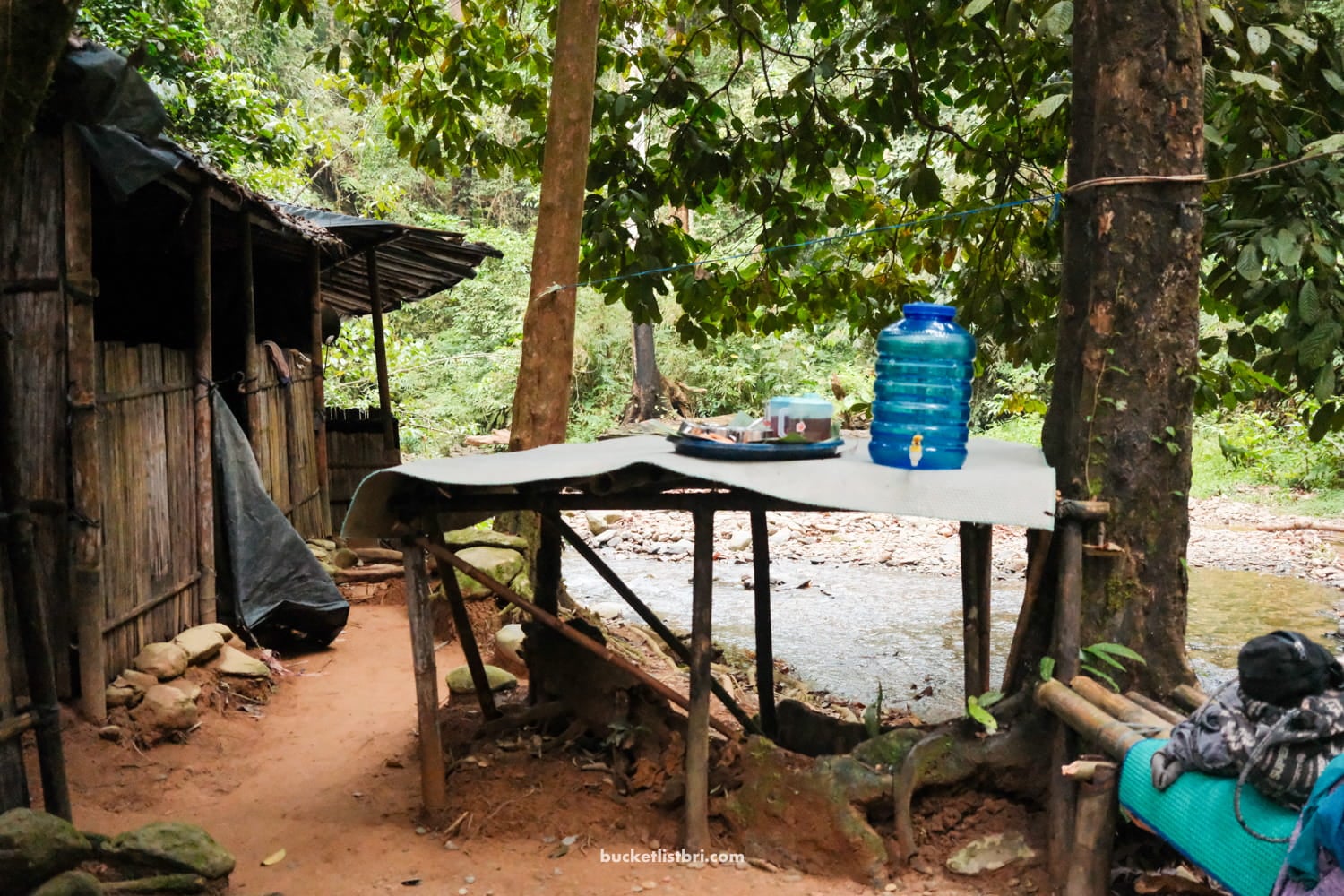
- Change of clothes to relax in (long-sleeve/pants encouraged for insects)
- Sleepwear
- Bathing suit for river dips!
- Quick-dry towel
- Extra day of hiking clothes (I wore the same trousers, but packed another long-sleeved shirt)
- Toilet paper roll
- Flashlight
- Minimal toiletries
- Battery pack – optional
- Inflatable pillow – optional
- Sleeping bag liner – optional
My Experience Trekking in the Jungle & Encountering Sumatran Orangutans
I hadn’t really expected or dreamt up a vision of what my first encounters with wild Sumatran orangutans would be like.
I certainly didn’t expect one mother to climb down the tree in front of me, and slowly pursue, picking up speed as she neared, the open backpack strapped to my tour leader’s back.
The way she angled for it, the way a local guide had pushed my friend out of the way, to safety… how the orangutan paused among us, strangers yet familiars. We were but an arm’s length away.
That was my first encounter, and I thought the moment couldn’t get any clearer. I thought, Wow, what luck!
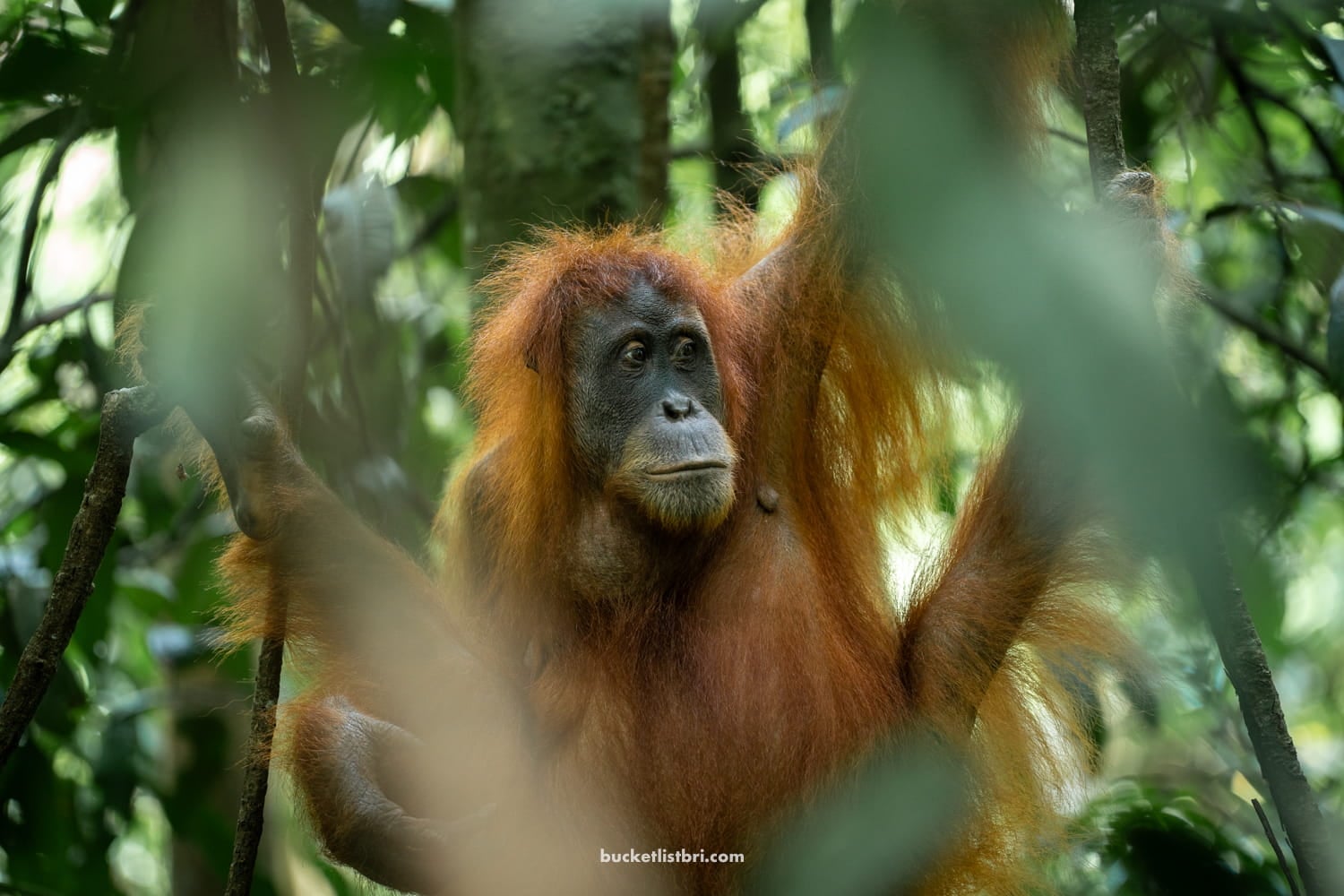
At least I thought so, until my next encounter, roughly an hour later, when our group rounded the corner and found, with such luck, an even bigger, even more wise and gentle orangutan, Wati, which turned out to be Pesek’s, the other female’s, mother.
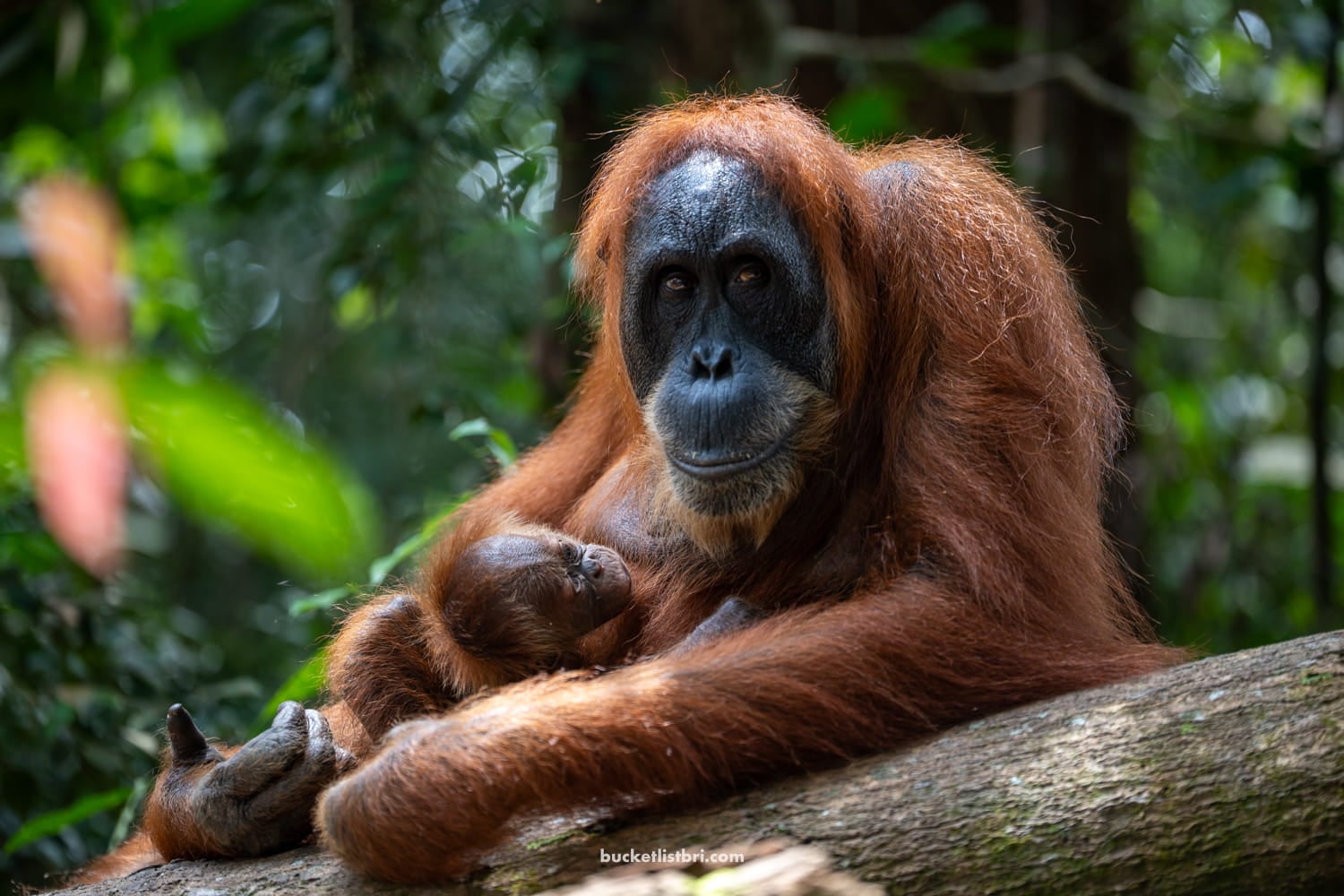
And to our surprise and awe, she was lounging on a thick felled tree, right in the sunlight, with a 2-week-old, wobbly infant, head full of spiked, frizzy red hair, suckling at her breast. She was both a grandmother and a new mom.
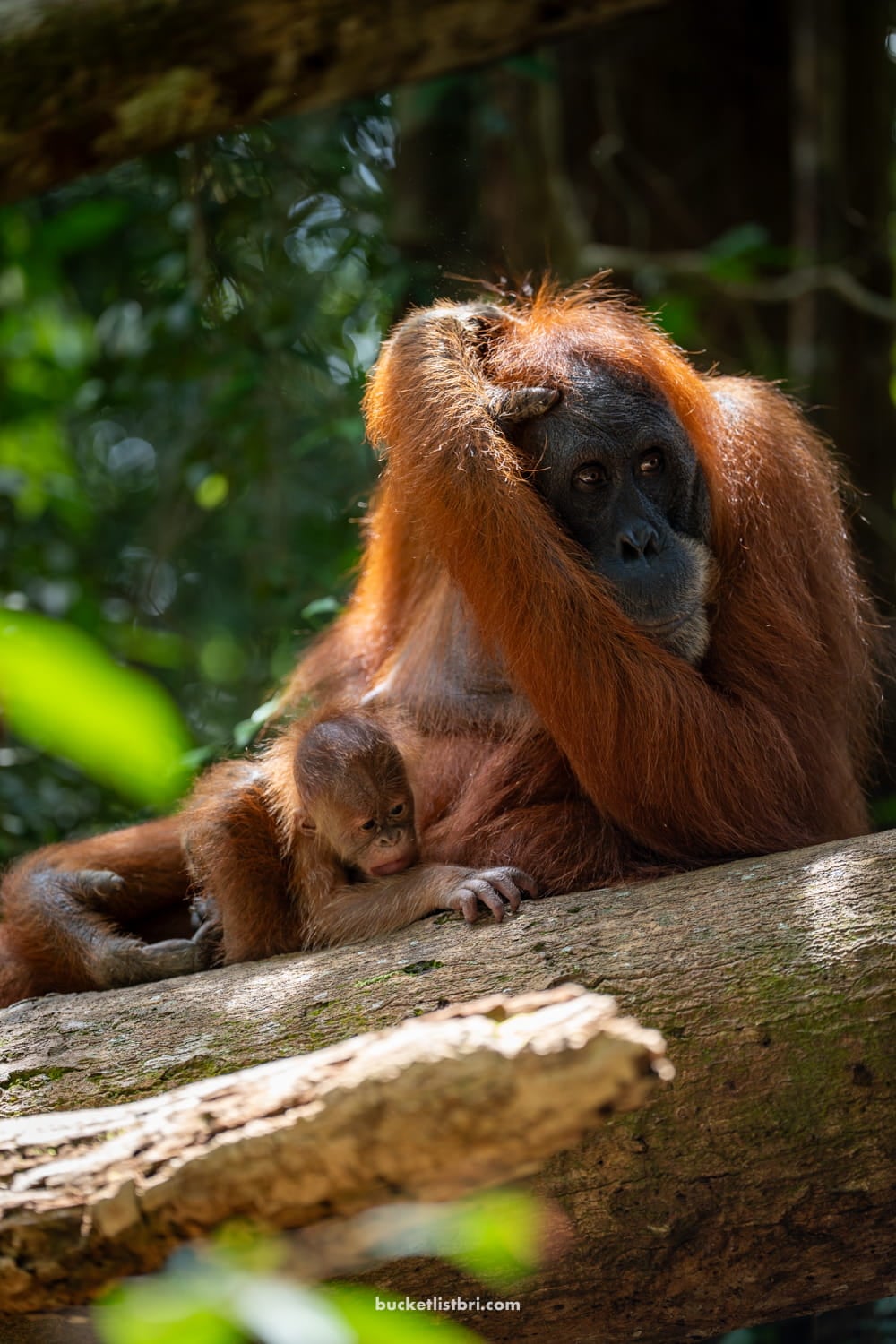
The way she looked at us, mere feet away, caught my breath. All I could do was whisper aloud, “Oh my god,” at every few intervals, as if on a timer.
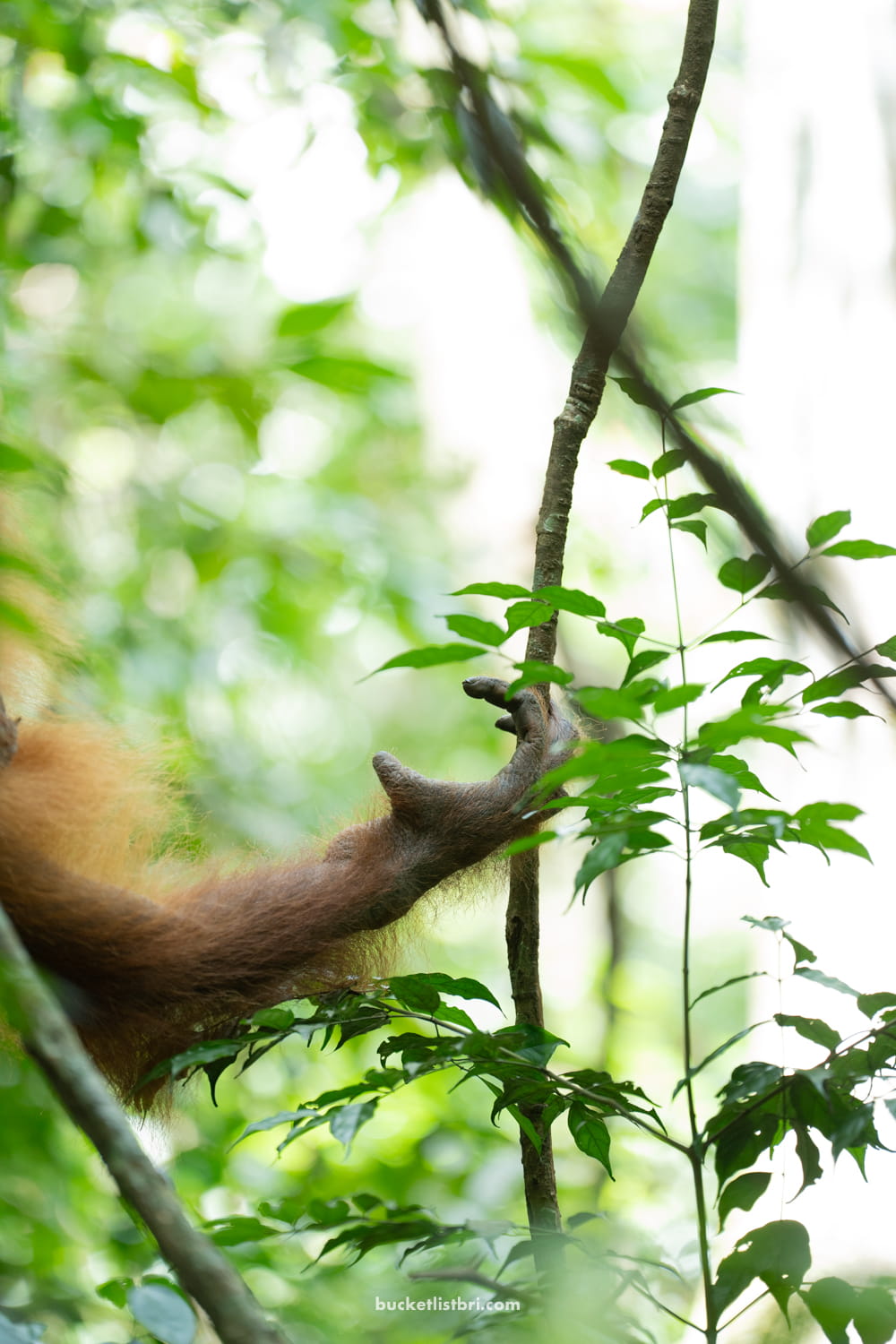
The way she peered into my camera, my lens, my very eyes, noting our presence, tickled my spine — at the pure connection of it all, as if I was looking at my ancestors in a time capsule. I noted her fingernails, her eyebrows, her enormous hands…
I lifted up my own, tiny in comparison. I wondered if she wondered, Well, aren’t those strange-looking, hairless apes?
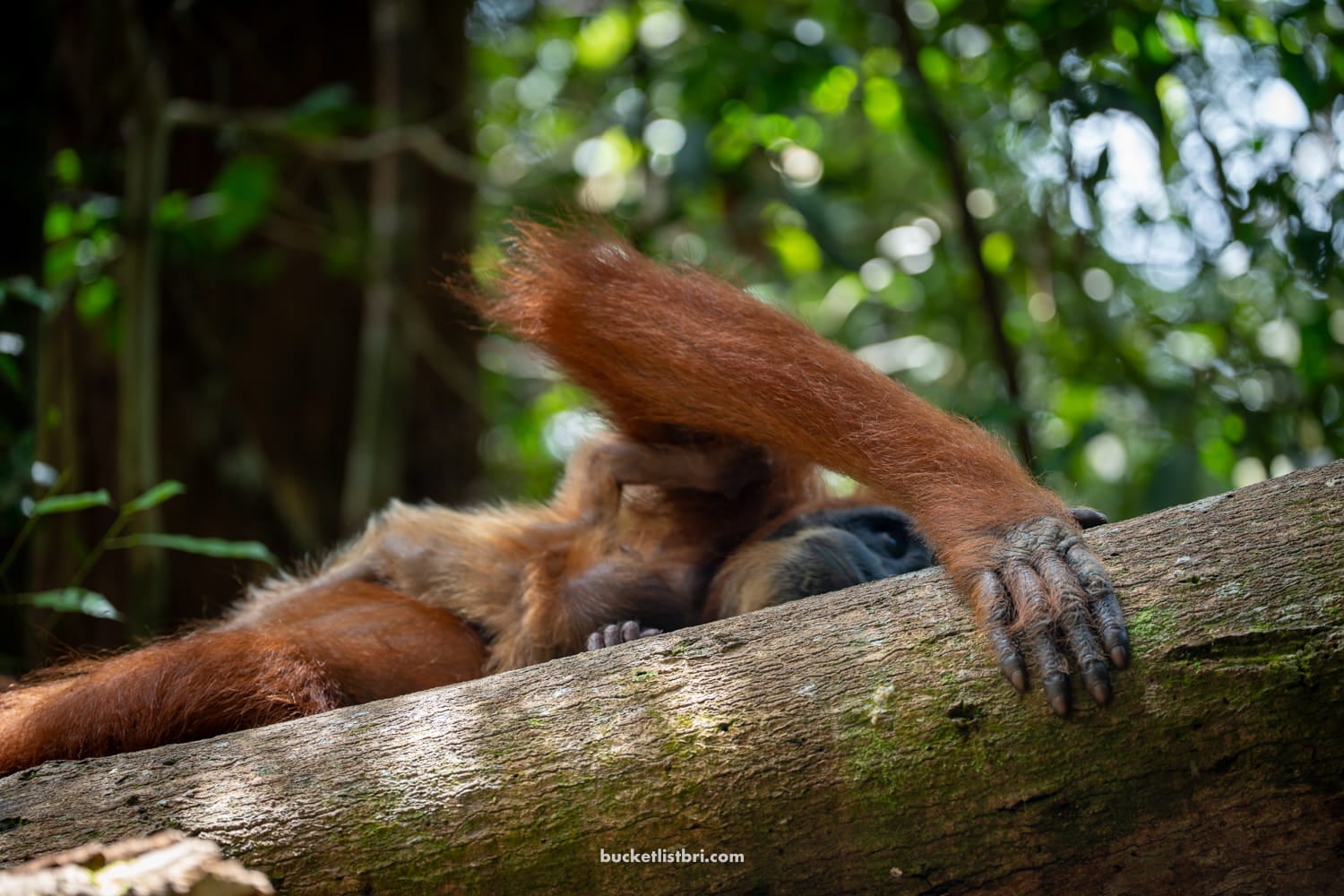
We gawked at her for minutes, which passed like seconds, until she slowly climbed down and strutted away, knuckles meeting the earth, baby clinging on with tiny fistfuls of her back hair.
Our group’s luck wasn’t over yet, though.
On top of sightings of pig-tailed and long-tailed macaques and Thomas’s leaf monkeys, we also struck gold on the morning of day two, on our way back to Bukit Lawang.
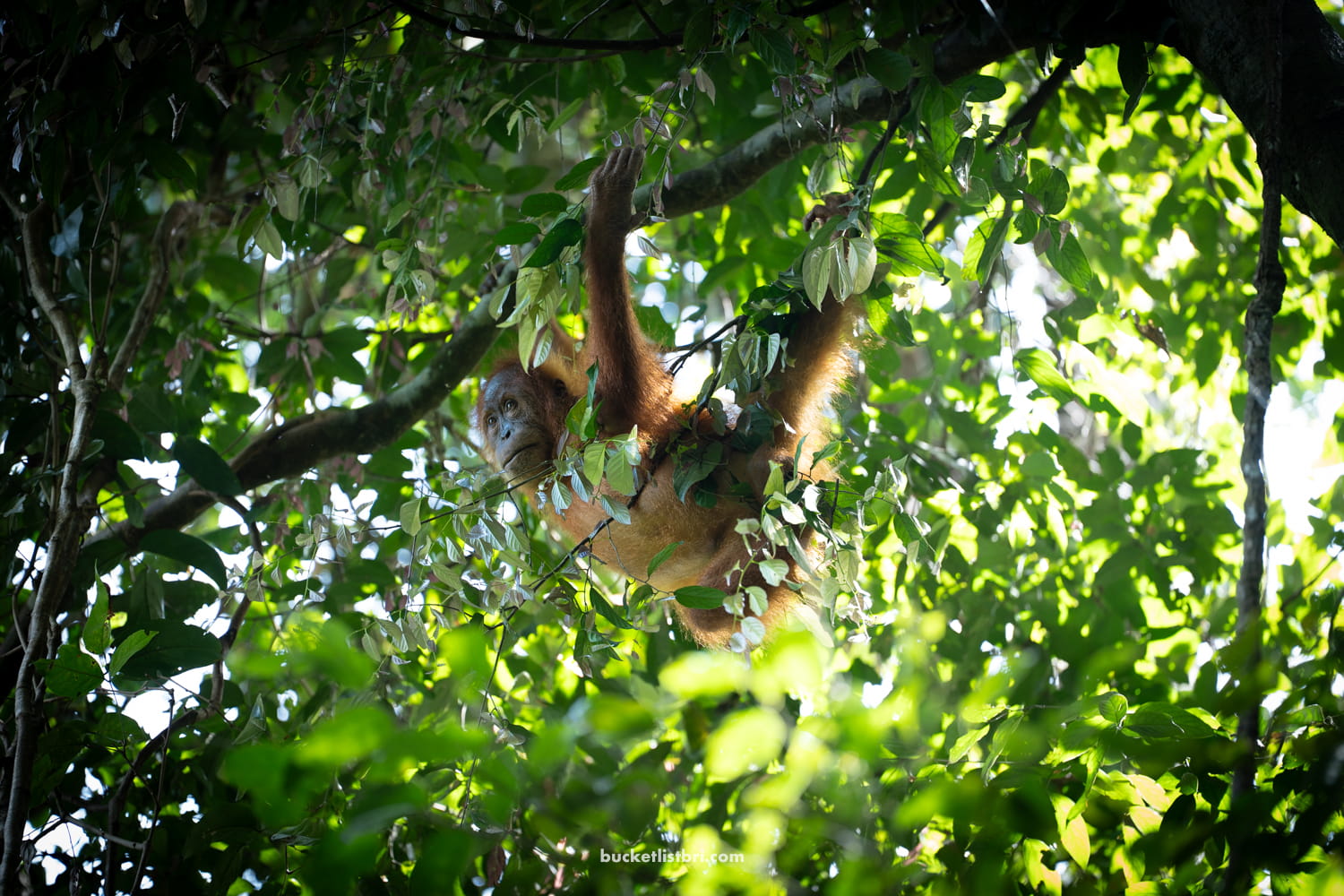
Up high, in a majestic, Avatar-like tree, were two more orangutans — wild, not semi-wild like the others — but again a mother and her child, this time grown, teenager-like.
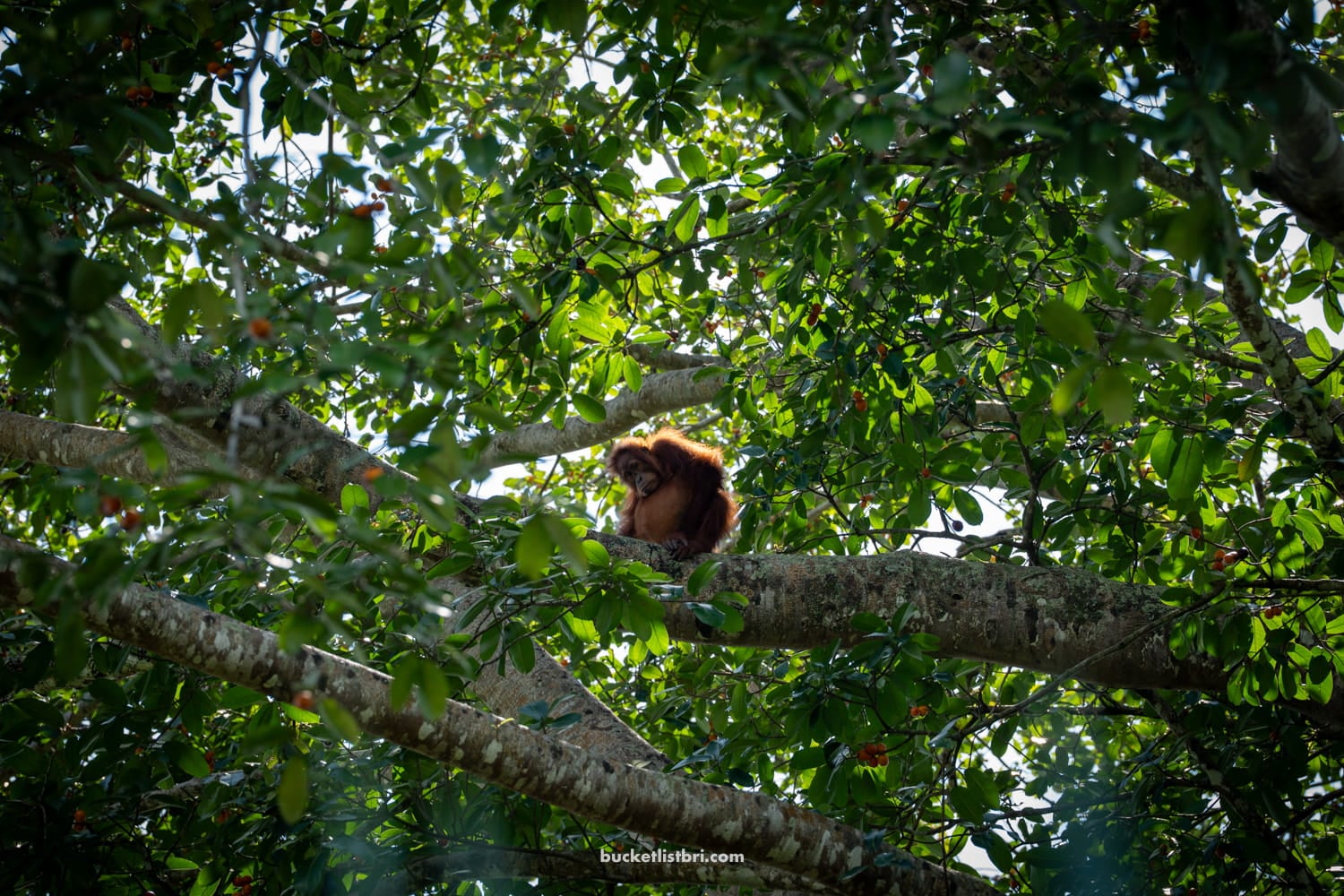
They were slumbering, then roused and showered the tree in urine, before climbing to the branch’s edge to peer out across the valley, across the wilderness.
For nearly 8,000 km², the tropical rainforest of Gunung Leuser National Park — one of the last wild habitats of these giant, gentle, endangered species — stretches ever on.
I blinked my eyes closed and inhaled the sultry air — hoping this moment, this wild, this life, will endure and be preserved for millennia to come.
Hi there. I’ve been doing a lot of reading about the ethical nature of these treks and tours as I am considering traveling to this region on my trip to Indonesia, but I am very conscious and concerned of contributing to any tourism that is extractive, unethical or unsustainable. I would love to hear your thoughts on this matter. Were your guides conscious to keep a distance from all wildlife? I have read there is a big a problem with guides that lure the orangutans in with food and it makes there very habituated ect. I would like to hear your thoughts. Thank you!
Hey Mac, thanks for reading! I agree — I am too, which is why I co-hosted this trip with Intrepid Travel. They are a B-corp travel company and I trust their local outfitters for things like this! Through them, we contracted Mail’s family business (Bukit Lawang Tour Trekking, linked in post). Can highly recommend them. They care and know more about the jungle and all the semi-wild orangutans than anyone else. That said, we had close encounters simply because the orangutans (females/mothers) were literally on our trail path. I can’t speak for all guides — some were lounging and being noisy and smoking which I didn’t like, but no one lured with food and nothing felt “off.” Mail and our team were super conscious of our safety and also the well-being of the apes and monkeys (and other wildlife, critters, and plants, etc!) that we encountered. I hope that helps!